Armed forces around the world are under growing pressure to increase both the frequency and realism of training. In doing so, they’re facing increasingly familiar constraints: limited assets, limited instructor availability, and the rising complexity of modern missions.
Traditional training methods are effective, but they are also expensive and resource intensive. An hour in a full-flight simulator can cost thousands of dollars when factoring in acquisition, maintenance, travel, and operations. Operating an actual fighter jet can exceed $40,000 per hour. Even marginal reductions in live-flight hours or simulator dependency can translate into significant savings. In that context, investing in high-end XR headset setups can deliver substantial long-term return on investment.
Yet not all virtual and mixed reality devices are built for mission-critical training. Many are designed for consumer or light enterprise use, not for the performance, security, and reliability demands of defense environments. In this blog post, we outline six must-have features for a military-grade VR/XR headset and explore what it truly takes to meet the strict standards of mission-critical training environments.
1. Uncompromising visual experience
Defense training applications demand uncompromising visual fidelity, which makes the choice of headset critical for achieving truly beneficial high-fidelity training outcomes. When evaluating the visual experience, consider the following:
- High resolution displays: A military-grade VR headset must deliver exceptional resolution to ensure realism and immersion for critical tasks.
- High graphical performance and low latency: Superior visual performance combined with minimal latency reduces VR-induced motion sickness and supports longer, more effective training sessions.
- Clarity at all distances: Optimized visual and gaze precision enables trainees to detect distant targets with confidence while also performing high-context close-up tasks, such as reading fine instrumentation or critical data.
- Mixed reality capabilities: Seamless integration of real-world tools with virtual elements or environments creates a cohesive and realistic training experience.
- Wide field of view: A broad field of view minimizes unnecessary head movement while enhancing situational awareness and spatial understanding.
- Operational flexibility: The headset must maintain consistent visual performance in demanding conditions, including dark environments and on moving platforms.
- Hand tracking: Your hands are tracked directly within the visible area of the headset, creating a natural immersive interaction experience for your training with no extra hardware needed.
2. Hardware built for secure environments
Organizations must be confident that devices behave predictably, that nothing transmits without authorization, and that both the supplier and its processes can withstand rigorous scrutiny. That starts with verified security practices:
- Your military VR headset provider should hold relevant certifications that demonstrate independently audited and continuously improved security controls.
- The headset should not store session data or environmental content.
- Processing should occur on a connected workstation where existing security controls, monitoring tools, and governance frameworks can be applied without introducing additional risk at the device level.
Operational flexibility must also extend to connectivity:
- In restricted or air-gapped environments, the headset should support full offline deployment, enabling operation without internet access.
- Devices should also be configurable to exclude radio components when required.
Finally, secure manufacturing and supply chain integrity are fundamental. For organizations operating under strict sourcing and compliance rules, suppliers must demonstrate adherence to standards such as Trade Agreements Act (TAA) requirements and ensure that electronic components are sourced from original manufacturers or approved distributors.
3. Secure and deployable software
Hardware is only part of the equation. In military XR deployments, software transparency, control, and capability are equally critical. Military organizations operate in environments where even a single undocumented component, unexpected data transmission, or uncontrolled update can introduce unacceptable risk.
- The software powering your military VR headset should provide full operational control.
- Log files should remain on the customer’s workstation and never be transmitted automatically.
- The platform should follow a secure Software Development Lifecycle, and automatic updates must be fully disableable so organizations can determine when and how changes are introduced in accordance with internal validation processes.
- For U.S.-based programs, additional validation such as a Certificate to Field (CTF) provides further assurance that the software meets stringent operational and security requirements for use .
At the same time, security cannot come at the expense of interoperability or performance. The headset should integrate seamlessly with training software and simulation tools already in use, ensuring it strengthens rather than disrupts your existing training ecosystem. To achieve next-level performance, it’s also beneficial for the software powering your headset to support advanced XR features and deeper customization, such as chroma key, masking tools, and programmatic control over camera settings.
4. Mission-ready ergonomics
Military VR headsets used for mission-critical training must prioritize ergonomics to ensure long sessions remain comfortable, focused, and effective.
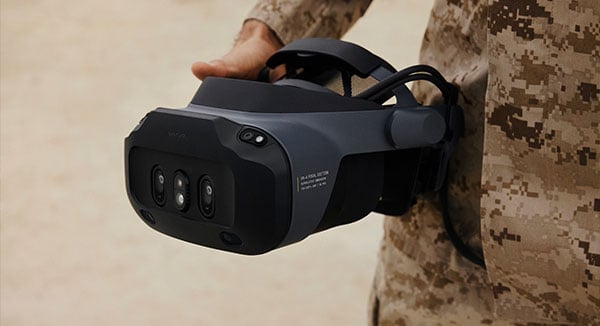
The headset should be designed for shared use, including support for eyeglasses, and provide a fit that accommodates a broad range of users. Adjustable contact points and adaptable structures should account for different head sizes, shapes, and facial geometries to ensure both stability and long-term comfort.
Weight distribution is particularly critical in head-mounted displays. Poor balance quickly leads to neck strain, fatigue, and reduced training effectiveness, while well-engineered weight distribution allows users to remain focused on the task at hand. Visual clarity and comfort also rely on precise interpupillary distance (IPD) adjustment, whether manual or automatic, to ensure proper optical alignment for every user.
Your military VR headset should also support seamless usability. The ability to quickly and comfortably transition in and out of immersive mode ensures the headset integrates seamlessly into the user’s natural workflow, mirroring dynamic, real-world military training environments.
5. Data-driven training analytics
Training for critical operations requires precise performance measurement and meaningful after-action review. It’s beneficial for your military VR headset to integrate with performance analytics systems or to include built-in tracking capabilities such as eye tracking. Integrating multiple biosensor data sources enables a deeper understanding of physiological and cognitive responses during training.
A high eye-tracking refresh rate is essential for generating accurate, reliable gaze-based analytics. Metrics such as scan paths, fixations, pupil dilation, and other stress indicators provide valuable insight into attention, workload, and emotional reactions, helping organizations better understand human behavior under pressure. By analyzing where and when a trainee looks, it becomes possible to assess attention, identify overlooked steps, and compare performance against expert benchmarks.
6. Dedicated technical support
As use cases and, in particular, the technical aspects of mixed reality simulators can be very specialized, it might be impossible to find support on more generic forums that focus mainly on consumer applications. Therefore, you should ensure that the immersive device manufacturer can offer direct help if problems or questions arise. Support tailored to your operational requirements ensures that even complex, customized training environments remain reliable, secure, and fully functional.
As we’ve outlined above, choosing the right device requires careful consideration. When realism, precision, and operational readiness are on the line, the wrong tool simply won’t suffice and can result in negative training. By focusing on these six essential areas, you can ensure your XR investment delivers ROI with realistic, data-driven, and secure training that optimizes cost and efficiency.
%20images/xr4-2026-hero.png?height=460&name=xr4-2026-hero.png)
.jpg?height=460&name=_w5a3107%20(1).jpg)