I still remember the pressure of live joint fires training when everything finally aligned.
Aircraft were available. Airspace had been allocated. The range was open. Weather was just good enough. Dozens of people across multiple units had worked for days to make a narrow training window possible. The planning for such events was often undertaken months in advance. Once the first serial began, there was no stopping. Every call mattered. Every movement had consequences. If something went wrong, there was no reset. You learned whatever the moment allowed and moved on.
Those experiences shape operators in some part for the operational realities they would face when deployed. They also expose a hard truth. Live training is invaluable, but it is also a scarce and fragile commodity and increasingly difficult to deliver at the scale modern forces require.
Across British and NATO defence training, the demands placed on Air Defense domains, Joint Fires teams, JTACs, and commanders continue to grow. Operations are becoming increasingly more complex, Joint, more distributed, and more time sensitive. Units are expected to deploy with shorter notice, integrate faster with partners, and operate across contested environments where air, land, maritime, and uncrewed systems are all in play. At the same time, access to live ranges, aircraft, and permissive training airspace is becoming more constrained, not less.
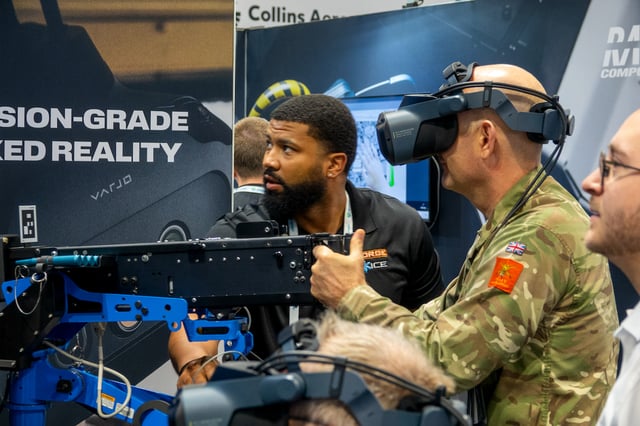
Modern defence training needs modern technology
This tension sits at the heart of modern defence training. Readiness is expected to increase, but the traditional mechanisms for building it are under pressure.
Live training has always forced compromises. Safety restrictions limit how far scenarios can be pushed. Costs limit how often they can be repeated. Complexity is often simplified because coordinating multiple assets in real time is logistically heavy and risky. As a result, much of the most demanding decision making is practised only occasionally, rather than continuously.
That gap between occasional exposure and consistent mastery matters. In Close Air Support, Air interdiction, Joint Fires, SEAD and indeed FPV Drone training, success depends on spatial awareness (at the tactical and strategic level), timing, communication, and the ability to process visual information under pressure. Small errors compound quickly. A misjudged distance, an incorrect assumption about a threat system, or a delayed clearance can fundamentally change outcomes. There is also an ever growing need to practice all these disciplines while incorporating Digital Aided systems and data networks.
The role of Simulation for Military Training
For years, simulation has been used to bridge some of this gap, but it was often limited to classrooms, flat screens, or highly centralised facilities, reserved for flagship organizations. What has changed over the last few years is not the ambition of training systems, but their realism, accessibility, and usability.
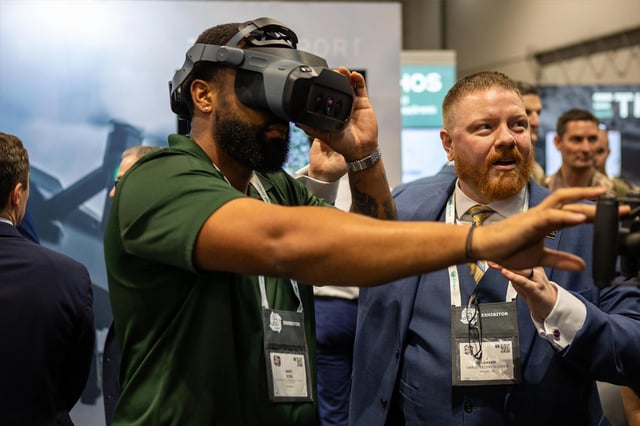
High fidelity extended reality has reached a point where it can replicate not just procedures, but the cognitive load of real operations. Visual clarity and depth perception allow operators to judge distances, terrain, and movement in ways that were previously impossible outside live ranges.
XR (Mixed reality) for JTAC training
Mixed reality enables real equipment to be used naturally while immersed in a virtual battlespace. Communications, coordination, and timing begin to feel authentic, not abstract.The ability to read, write, operate (equipment) and communicate as if you would outside is the new normal.
This matters because effective training is not about spectacle. It is about repetition under realistic pressure. XR allows teams to rehearse complex missions repeatedly without limitations of assets and real estate. Scenarios can be adapted as threats evolve. Mistakes can be examined immediately, corrected, and practised again.
During multinational exercises and operational rehearsals, I have seen how powerful this becomes. Units that rehearsed joint fires missions in immersive simulation arrived at live ranges already aligned. Communication was sharper. Decision making was faster. Operators were thinking ahead rather than reacting. Live serials became confirmations of competence rather than first exposures.
Equally important is where this training happens. Centralised centres will always have a role, but readiness cannot depend solely on scheduled events. Forces deployed forward or operating in contingent postures need to train where they are, when they can. Portable, deployable XR systems allow individuals and teams to maintain proficiency without being removed from their operational context. Training becomes something units own, not something they wait for.
One of the most telling indicators of maturity in modern XR systems is how quickly operators can use them. When soldiers, JTACs, and instructors are able to plan, rehearse, and execute complex scenarios with minimal technical support, the technology disappears into the background. Training becomes about thinking, communicating, and deciding, not about learning an interface.
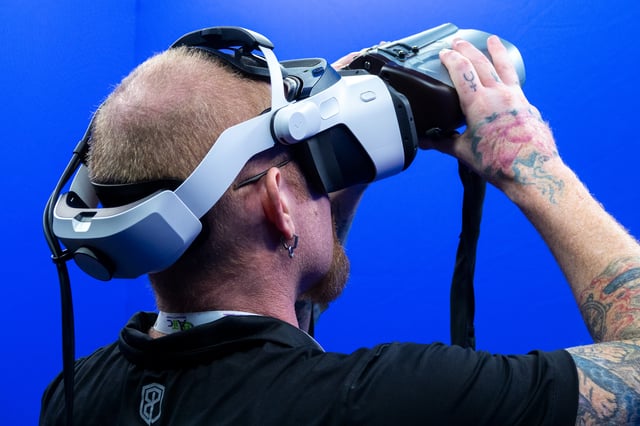
This is why adoption is accelerating now. Defence organisations are under pressure to do more with less, but also to standardise and accredit training and increase readiness across larger forces. XR is no longer an experimental add on. It is becoming a core component of how competence is built and sustained.
XR and Live training working together
None of this diminishes the value of live training. Live fire exercises remain essential. They test people and systems in ways simulation never fully can. But they should not be the only moments when complexity is introduced. XR fills the space between classroom instruction and live execution, allowing forces to arrive at the range already prepared for what matters most.
For the next generation of operators, training across physical and virtual environments will feel entirely natural. They will not see XR as a substitute for reality, but as part of it. A way to train more often, more realistically, and with fewer constraints.
Readiness has always been about preparation. Today, mixed reality is becoming one of the most effective ways to deliver it.
-Nick
Learn more about existing implementations of XR for JTAC training here