Why Choose XR for Training and Simulation | Advanced Solutions with Varjo
Mixed reality brings lifelike, portable training to land, sea, air, and beyond. See how XR cuts cost and deployment time for defense programs.
Have your voice heard: Take the State of XR survey
Keep trainees fully immersed and engaged with an unmatched level of realism. XR/VR simulation training with Varjo replicaes the exact feeling and conditions of real life and provides the most natural and fully immersive training simulation ever experienced.
SIMULATE ANY SCENARIO WITH HIGHEST PERFORMANCE VR/XR
Training in an immersive VR/XR setting puts people in the right frame of mind the moment they enter the simulation environment, helping professionals to practice their craft, prepare for threats, push boundaries, and make history in an environment that is safe.
Virtual reality training uses immersive technologies to simulate real-world environments and tasks in a controlled, digital setting. Trainees wear virtual (VR) or mixed reality (MR) headsets to engage with lifelike scenarios that mirror real-life situations, from flying helicopters to performing medical procedures, without risk or physical constraints. This approach enables safe, repeatable, and highly realistic practice that prepares learners more effectively than traditional methods alone.
Creating VR training starts with clearly defining the specific skills or scenarios learners need to practice. Map out your use case by considering what trainees will do in the experience, whether they need to collaborate, move around, or use their hands, as this helps determine the technical requirements.
Choose VR/XR technology that supports the level of visual fidelity, performance, and software compatibility your training demands, especially if photorealism or accurate color representation is important. You can develop the virtual environments and interactive scenarios using 3D engines such as Unity or Unreal Engine. Make sure to consider the necessary hardware integrations and tracking systems to ensure highest level of immersion. Test the training with users, gather feedback, and refine the experience to optimize learning outcomes.
Using VR or XR for training begins with preparing the environment by setting up headsets, tracking sensors, compatible computers, and ensuring the software is properly installed and calibrated. Trainees should receive an introduction to the system, including how to wear the headset, navigate controls, and interact within the virtual simulation.
Performance can be monitored and assessed through tools like eye tracking, biometrics capture, and analytics to evaluate actions, decisions, and response times. Because VR enables unlimited repetition, trainees can continue practicing complex or high-risk scenarios until they achieve competence.
30%
Time cut from achieving the first solo flight (Embry-Riddle Aeronautical University, 2022)
80%
Size and weight reduction from old systems (Fast Company & Loft Dynamics, 2024)
100%
All study pilots answered ‘yes’ when asked if they would recommend the use of VR simulation (Gouedy, Fendley & Wolf, 2024)
$350M
Annual savings potential for institutions (Defense Innovation Unit 2023)
“The benefits of using immersive technologies for fighter pilots come across numerous realms, from cost savings to environmental impacts to safety.” Chris Metel - Prepar3D Engineering Program Manager, Lockheed MartinRead case study
Read case study“In the future, mixed reality is going to be one of the cornerstone technologies of maritime training.”
Johan Ekvall - Head of Products, Wärtsilä Voyage
“The newest update to the XR-4 Series allows us to feel confident that we can meet our customer requirements.” Bartek Panasewicz - VP Training Systems LandRead case study
Read case study“We chose Varjo headsets specifically because Varjo is a market leader and selecting them was simply a no-brainer.”
Assistant Professor Umberto Saetti
Read case study“Our ultimate goal is to expand VR usage into every area where it can effectively support astronaut activities.”
Florian Saling - XR Software Engineer, European Space Agency
Unmatched features for VR simulation training
Mixed reality brings lifelike, portable training to land, sea, air, and beyond. See how XR cuts cost and deployment time for defense programs.
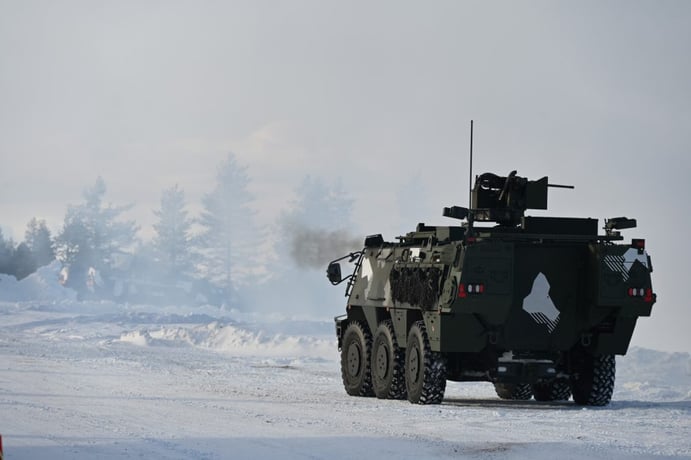
Patria's XR vehicle crew training simulator offers improved immersion and a smaller physical footprint than conventional display setups.
Company News / August 29, 2023
Varjo's XR headsets are powering the U.S. Army's RVCT Air Program, delivering high-fidelity, mixed reality training for Apache, Chinook, and Blackhawk pilots with advanced video pass-through and TAA-certified security.
Ready to redefine reality?